Lost In Choice
Toy Finder — Too many toys, no idea what to buy
- Industry
- E-commerce
- Project
- Product experiment
- Challenge
- Choice overwhelm
- Outcome
- Credibility-stacked structure
Project overview
ElevationThe site as visitors saw it
A product experiment, not client work. Toy Finder was my own test of decision architecture for parents drowning in toy choices. Instead of presenting hundreds of options, I designed a system showing only 3 expert-backed recommendations organised through a 4-tier trust framework.
The project challenged a fundamental assumption: Do parents need more choices, or more confidence in fewer choices?
I built a trust architecture system that organised disparate credibility signals, expert reviews, brand recognition, parent testimonials, lifestyle imagery, into a coherent decision framework that matched how parents actually evaluate toys.
Project Status: Paused due to content scalability constraints. The editorial infrastructure required to maintain expert-vetted recommendations across age ranges and developmental stages exceeded available resources.
Challenge
Section A–AThe structure underneath
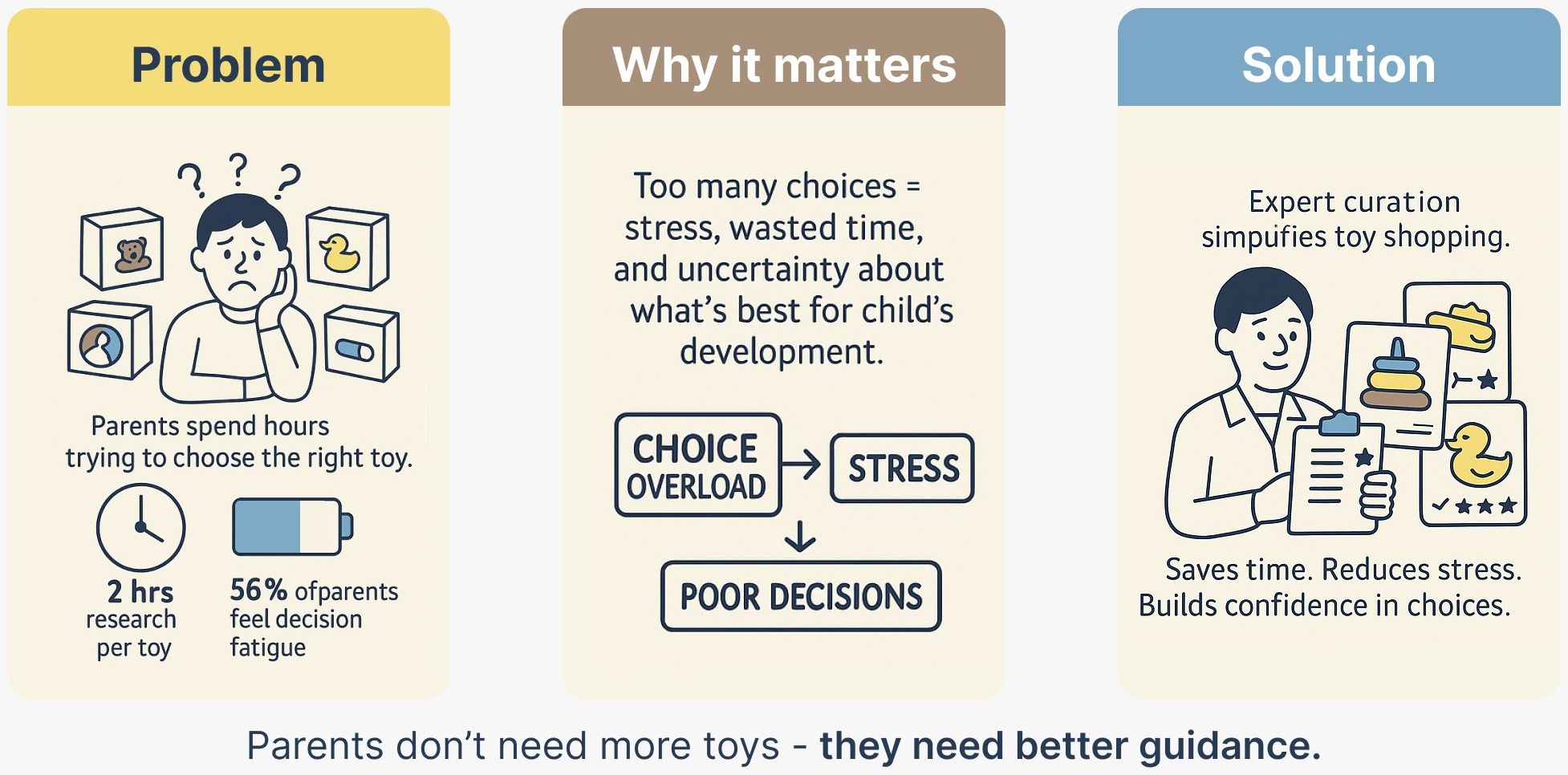
Parents face overwhelming choice when selecting toys online. Hundreds of options across multiple retailers, conflicting reviews, unclear age appropriateness, and no clear signal of what's actually worth buying.
The real problem wasn't finding toys, it was knowing which toys to trust. Should they follow expert recommendations? Trust parent reviews? Look for award winners? The cognitive load of evaluating all these signals while filtering by age, developmental stage, and play type created decision paralysis.
Traditional e-commerce patterns (endless catalogues, filter overload) abdicate this organisational work to users. Parents don't need more options. They need structure that builds confidence.
Approach
I started by mapping the parent decision journey: What questions do they ask? What builds confidence? When do they commit to purchase?
My research revealed four trust signal types parents use:
- Expert Authority - Professional recommendations, developmental appropriateness
- Brand Recognition - Familiar brands signal quality and safety
- Social Proof - Other parents' testimonials and experiences
- Real-Play Evidence - Photos of toys in real use
I organised these into a 4-tier trust architecture, designing how each layer reinforced the others rather than competing for attention.
Then I mapped the cognitive flow: qualification (age/developmental stage) → consideration (trust signals) → validation (purchase confidence). The information architecture needed to mirror this natural buyer journey, not impose e-commerce convention structure.
Solution
PlanThe new structure
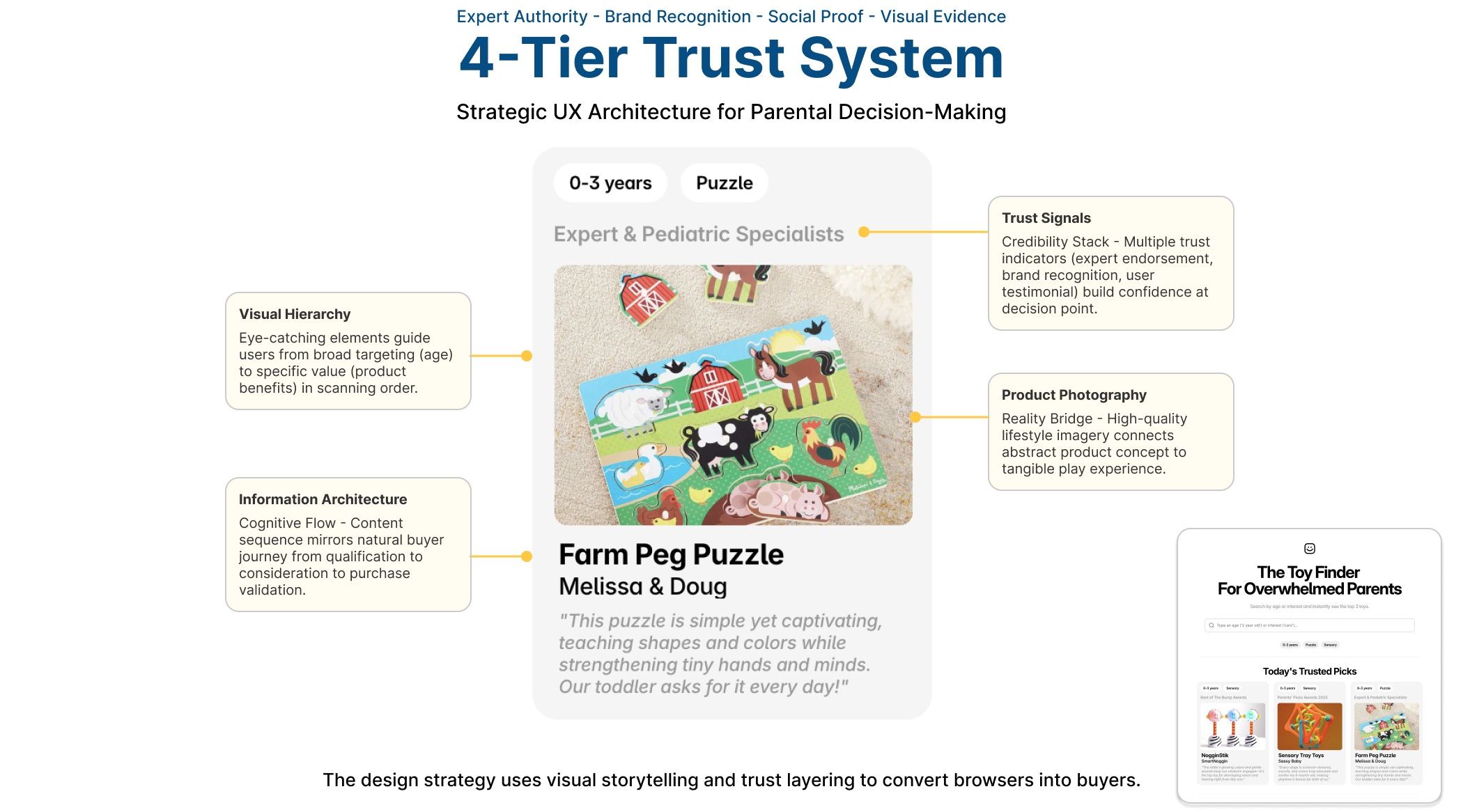
I designed a trust system with four integrated layers:
Tier 1: Expert Authority
Developmental psychologist endorsements positioned at the top, immediately establishing credibility and educational value.
Tier 2: Brand Recognition
Recognisable brand logos appeared consistently without overwhelming the primary message—familiar names that signal reliability.
Tier 3: Social Proof
Parent testimonials structured to answer specific questions: "Does this hold attention?" "Is it worth the price?" "Will my child actually use it?"
Tier 4: Real-Play Evidence
Photos of toys in real play came last in the stack, so parents could picture the toy at home once they already trusted the pick.
The cognitive flow matched the buyer journey:
- Qualification - "Is this right for my child's age?" (developmental filtering)
- Consideration - "Why should I trust this?" (4-tier credibility stack)
- Validation - "Can I picture this working?" (seeing the toy in real play, plus a 3-option structure that reduced paralysis)
Decisions
Credibility Stacking
Instead of presenting trust signals sequentially, I layered them so multiple indicators appear together. This "credibility stack" builds confidence faster than isolated signals. Parents see expert endorsement + brand recognition + social proof simultaneously, reducing the need to hunt for validation.
Decision Order Over Alphabetical Lists
Rejected standard e-commerce patterns (grid layouts, alphabetical sorting). Instead, ordered content by how parents decide: age → benefit → trust → image. Natural scanning order matched decision-making order.
Three Options, Not Unlimited Choice
The entire system relied on curation. Showing 3 expert-backed options instead of 100+ removed decision fatigue. This constraint forced me to design a trust system strong enough to justify "Why these three?"
Cognitive Flow Mirroring Buyer Journey
Content sequence (qualification → consideration → validation) matched how parents actually evaluate toys, not how products are traditionally organised (category → filter → sort).
Result
Structural Improvements:
- Organised 4 disparate trust signal types into coherent hierarchy
- Designed cognitive flow that matched natural buyer behaviour
- Created reusable trust framework applicable across age ranges and toy categories
User Benefits:
- Clear mental model for "why should I trust this recommendation"
- Reduced decision paralysis through structured choice (3 options, not 100+)
- Faster path to confident purchase through layered credibility signals
What I Learned:
Trust architecture requires both structural clarity (organising signals) and content depth (maintaining quality). I solved the structure problem but couldn't solve the content scalability problem within project constraints.
The IA worked. The editorial model didn't scale.
Sound familiar?
See what fixing it would take, from one page to the whole structure.
Not sure? Ask For A Free Opinion