Content & Experience Strategy
Lost In Sameness
Industry
Service
Challenge
Outcome
(01)
Project overview.
Sentient Professional Wellbeing is a Sydney-based psychology and counselling practice serving diverse communities. Their website communicated credentials but lacked differentiation. The messaging described what they did without showing why someone should choose them. Navigation was service-centric, forcing users to decode professional terminology before understanding if this practice was right for them.
I restructured their entire experience, navigation, landing page messaging, brand story, and visual hierarchy, into a cohesive system organised around emotional needs rather than service categories. The transformation turned a generic therapy website into a clear, compassionate positioning that matches how people actually seek mental health support.
(02)
Challenge.
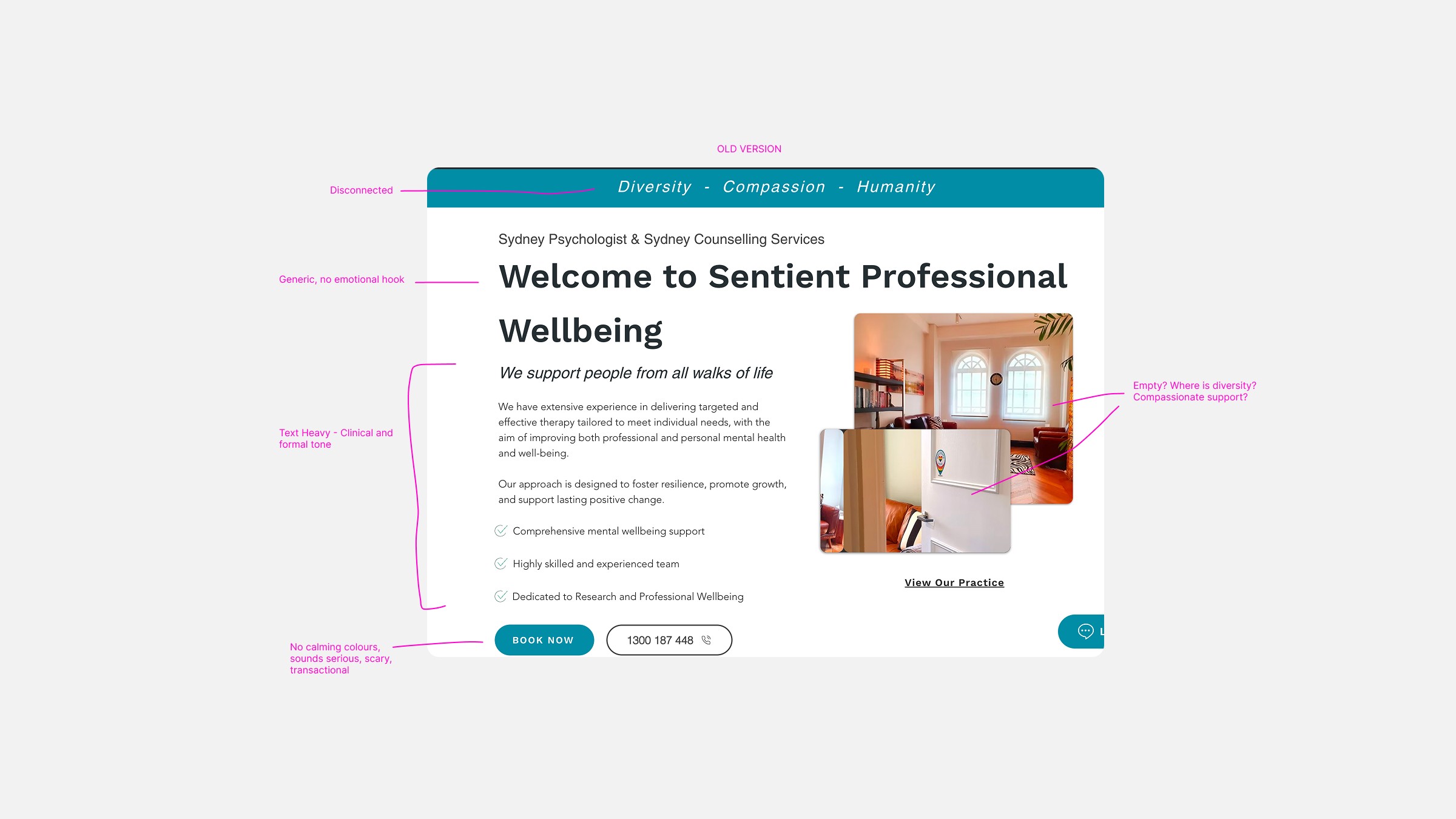
The original site opened with "Welcome to Sentient Professional Wellbeing" and listed services through descriptive but vague messaging: "We support people from all walks of life." Bullet points itemised offerings without hierarchy or emotional connection. Navigation presumably followed clinical categories, asking users already under stress to translate professional language into personal needs.
The real problem wasn't information availability. It was structure and positioning. Multiple therapy practices in Sydney offer similar services. Sentient's actual differentiators (diversity-focused care, compassionate approach, highly skilled team) were buried in body copy. Users had to work to discover what made them different.
The landing page created cognitive friction. Someone seeking mental health support, already navigating vulnerability and uncertainty, encountered generic institutional messaging instead of clarity about "Is this practice right for me?" The information architecture didn't match the emotional journey of choosing a therapist.
(03)
Approach.
I audited the existing content to identify what was already present but structurally buried, then reorganised it into a coherent system that surfaced existing value.
My audit process involved:
Analysing existing content to find stated values and supporting evidence scattered throughout the site
Identifying their core positioning (diversity, compassion, humanity) that appeared in isolated fragments
Mapping existing content to those values to create structured differentiation rather than scattered claims
Restructuring navigation from service categories to outcome-based organisation
Building landing page hierarchy that surfaced existing differentiation rather than requiring users to excavate it
Three core differentiators emerged from existing content:
Diversity & Inclusion – They already served multicultural, multilingual, neurodivergent communities but didn't structure this prominently
Compassionate Care – References to empathy and evidence-based practice existed but weren't organised into clear value propositions
Accessible & Expert – Credentials and service accessibility details were present but not positioned as differentiators
These weren't invented. They were the organising principle the existing content needed.
I built the information architecture around making implicit value explicit: their scattered values became a structured 3-pillar framework, supporting content got organised under relevant pillars, and navigation shifted to match user emotional needs rather than professional terminology.
Visual hierarchy reinforced the IA decisions. Icons created visual anchors for existing value propositions, typography created scannable priority, and layout gave structure to dense, disorganised content.
(04)
Solution.
I restructured the experience into a multi-layer system where navigation, messaging, brand story, and visual hierarchy all worked together:
Landing Page Messaging
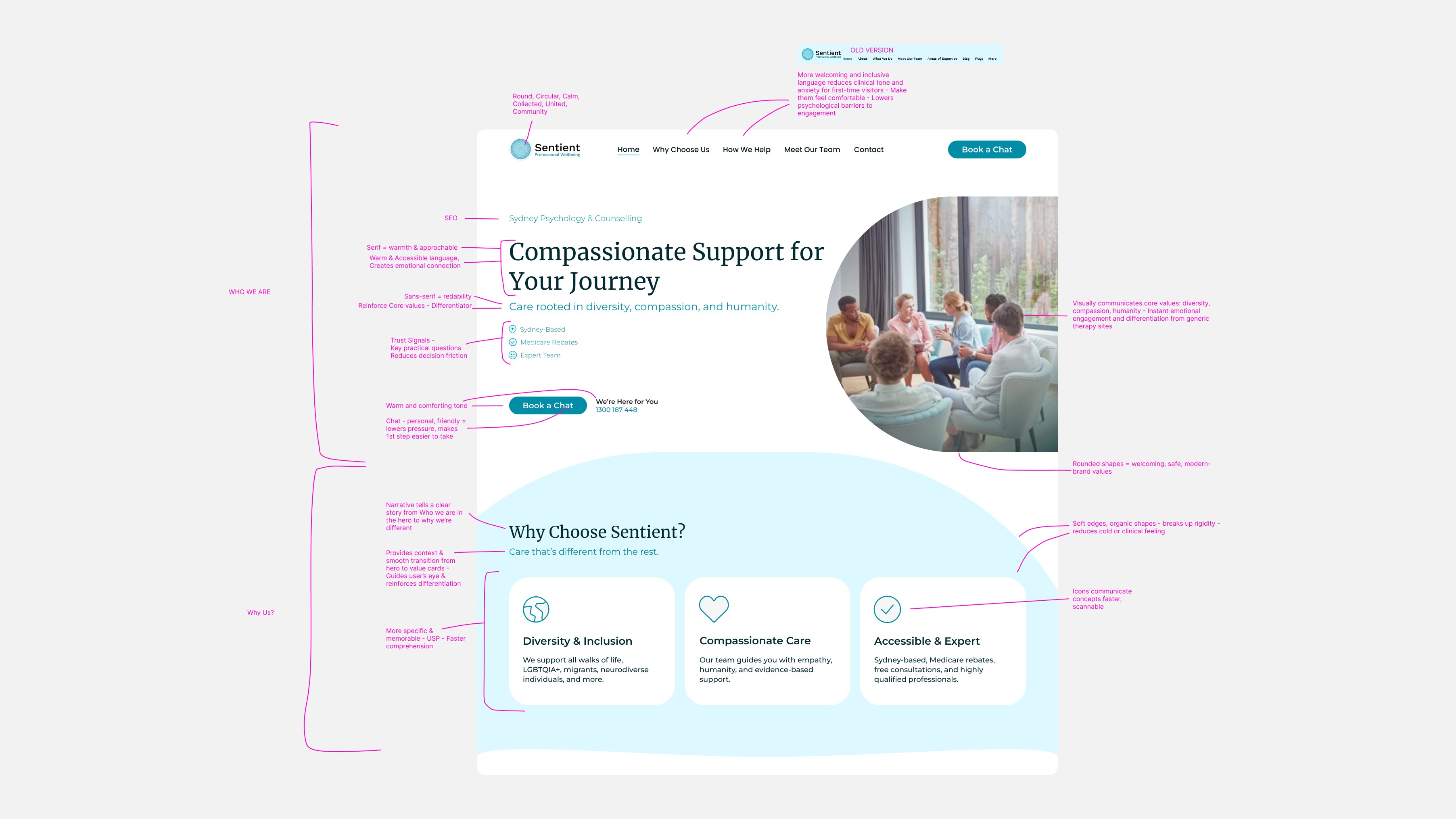
Replaced institutional welcome with outcome-focused headline: "Compassionate Support for Your Journey" with tagline "Care rooted in diversity, compassion, and humanity." This immediately communicates emotional tone and differentiation.
3-Pillar Differentiation Framework
Organised their value proposition into scannable structure:
Diversity & Inclusion (visual: globe icon) – Clear signal for multicultural, neurodivergent communities
Compassionate Care (visual: heart icon) – Evidence-based support delivered with empathy
Accessible & Expert (visual: checkmark icon) – Credentialed professionals, flexible access
"Why Choose Sentient?" Section
Addressed the trust question directly below the fold. Instead of forcing users to piece together differentiation from scattered content, I structured the answer prominently with supporting evidence.
Navigation Restructure
Moved from service-centric categories to intent-based structure:
"Why Choose Us" – Immediately addresses differentiation
"How We Help" – Outcome-focused service organisation
"Meet Our Team" – Builds trust through credentials and humanity
"Contact" – Clear next step
Visual Hierarchy System
Typography, colour, and spacing reinforced the IA decisions. Teal accent created visual threading through key actions (Book a Chat CTA). Photography showed real connection rather than stock therapy tropes. Clean layouts gave breathing room to emotionally complex content.
(05)
Decisions.
Emotional Clarity Over Clinical Credentials
Led with "Compassionate Support for Your Journey" instead of professional titles and service lists. Mental health seekers need emotional reassurance first, credentials second. This positioned Sentient as a guide, not an institution. The structure builds trust before asking for commitment.
Differentiation Upfront
The 3-pillar framework immediately answers "What makes you different?" Most therapy sites bury this. Placing it prominently reduced the cognitive work of comparison shopping during an already stressful decision process.
Story-Driven Hierarchy
Organised content flow to match the emotional decision journey: "Do I feel safe here?" → "What makes you different?" → "Can you help with my specific situation?" → "How do I take the next step?" This mirrored natural behaviour rather than imposing professional categorisation.
"Why Choose Sentient?" As Navigation Anchor
Making this a primary navigation item rather than an About page subsection signals confidence and respects the comparison mindset users arrive with. It acknowledges users are evaluating options and provides clear differentiation without forcing discovery.
Visual System As IA Support
Icons weren't decoration. They created visual anchors for scanning. Someone overwhelmed can process "globe icon = diversity, heart icon = compassion, checkmark icon = expertise" faster than paragraph scanning. Colour, typography, and spacing reduced density while maintaining information completeness.
(06)
Result.
The website transformed from a generic therapy practice site into a clearly positioned, emotionally resonant system that organises the entire choosing-a-therapist journey.
Structural Improvements:
Organised disparate value propositions into scannable 3-pillar framework
Created navigation that matches user questions rather than service categories
Built messaging hierarchy that mirrors emotional decision journey
Unified visual system that reinforces information structure
User Benefits:
Immediate clarity about what makes Sentient different
Reduced anxiety through compassionate, accessible messaging
Clear path from "exploring options" to "ready to book"
Scannable structure that respects cognitive load during stressful decisions
System Integration:
This wasn't a visual redesign with IA added. It was a full ecosystem transformation where navigation structure, content messaging, and visual hierarchy all worked as one organising system. Each layer reinforced the others, creating coherence that matches how people actually seek mental health support.
The architecture does the emotional work so users don't have to.