The Setup
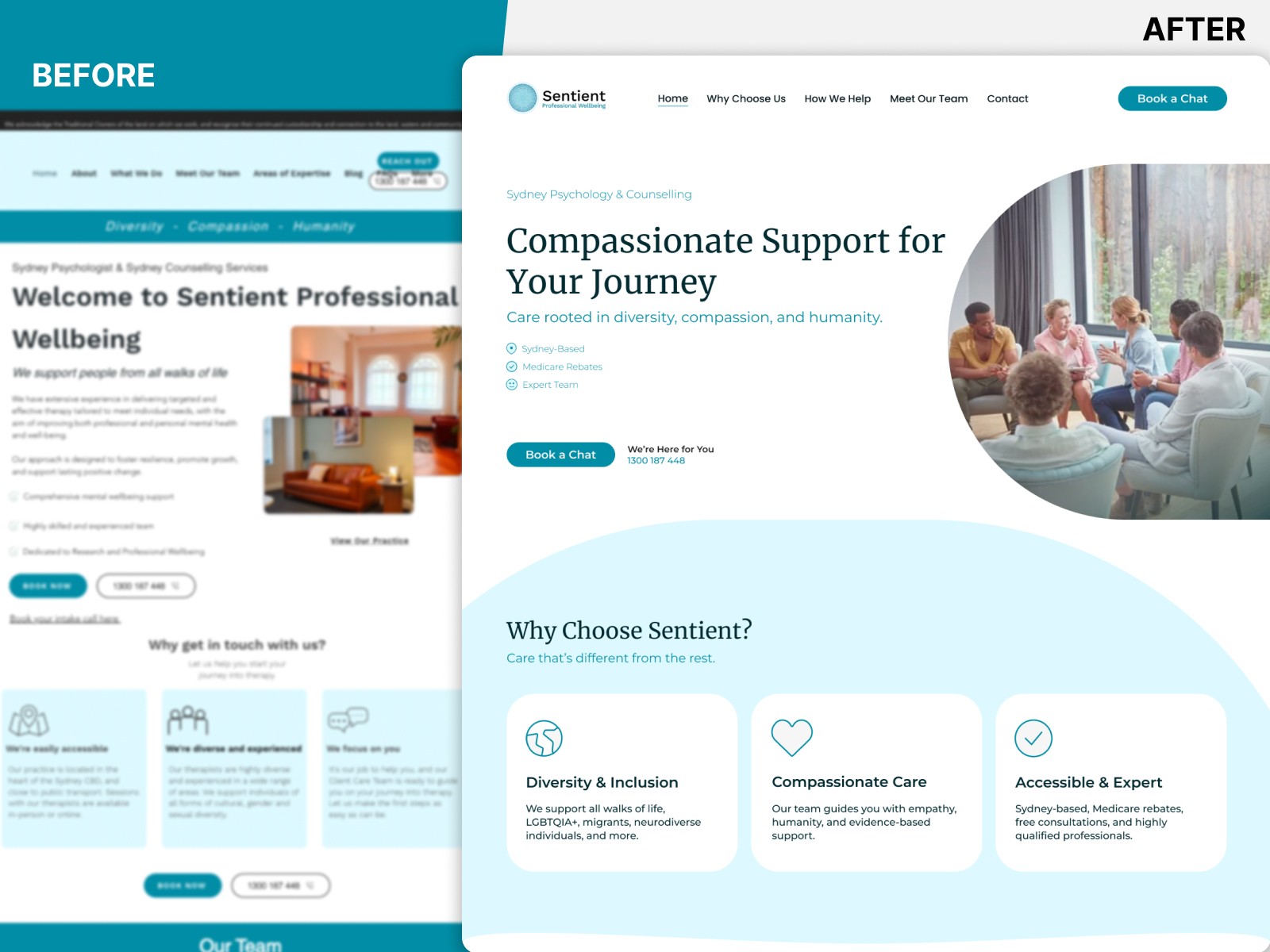
The design test came late Wednesday afternoon. Design test due Friday at noon. Two deliverables: social media ads and a website redesign panel for Sentient Professional Wellbeing, a Sydney psychology practice.
I had roughly a day for each. Less than 24 hours for Sentient.
I looked at their existing site: generic welcome message, scattered bullet points, buried differentiators. I looked at the agency's portfolio: clean, strategic, systems-focused work. I looked at the brief: "Design 1-2 panels to help modernise their experience."
I couldn't just make it look better. Not when I could see what was actually broken.
What I Actually Did
I didn't design website panels. I reorganised their entire positioning.
I audited their existing content to find what was already there but structurally buried. Their values (diversity, compassion, humanity) appeared in isolated fragments across the site. Supporting content existed but wasn't organised into anything coherent.
I mapped their scattered messaging to those three values and built a framework: a 3-pillar differentiation system (Diversity & Inclusion, Compassionate Care, Accessible & Expert). I restructured their navigation from service categories to outcome-based organisation. I rewrote their landing page hierarchy to surface existing differentiation rather than requiring users to excavate it.
I created icons, chose typography, built visual hierarchy. I made the implicit explicit through information architecture.
Under time pressure, my instinct wasn't "make this look emotionally right." It was "organise what's already here into coherent structure."
I couldn't help myself.
The Interview
I submitted Friday afternoon, I got the call. "We're impressed. Let's schedule an interview."
The call with the CEO, went well. Until it didn't.
We talked about the role, my background, what I'd accomplish in a year. Then I asked the question that had been nagging me: "I'm still confused about what exactly the seniority of this role is. The job description was more execution, but the design task felt strategy focused. What are you actually looking for?"
His answer was diplomatic but clear: "In the early stages, it'll be focused more on execution where you can learn. Over time, shifting more focus towards strategy."
They wanted someone who could grow into strategy. I was already there.
When he described what success looked like in a year, he outlined the difference between junior and senior designers. Junior designers execute. Senior designers reflect and evolve the process.
I immediately referenced my Brainmates work. "We always reviewed after we put websites online. That's a very fun process for me."
I was describing something I'd already done, not something I wanted to learn.
The call ended positively. I was excited. But somewhere underneath, I knew I'd shown them I was already operating beyond what they needed.
The Mismatch I Felt But Couldn't Name
Weeks of silence. Polite check-ins. Holiday delays. "We'll reach out in early January with next steps."
January came. Nothing.
Here's what I sensed during that interview but couldn't articulate: I applied for a Digital Designer role that was execution-focused with growth potential.
The job description asked for someone to design assets for websites, social media, email campaigns, and digital ads. Someone who could work fast across multiple formats. Someone with "2+ years of relevant experience" in production design.
They needed a mid-level designer who could be trained into strategy work over time.
I showed up already doing senior-level systems thinking.
I over-delivered in the wrong direction. Not just in the design test, but in the interview itself. When the CEO described future aspirations, I referenced past strategic work. When he outlined the senior designer mindset, I said "that's what I already do."
I couldn't help but show I was already beyond where they needed me to start.
The Pattern I Was Still Repeating
I applied because I needed work. Because they mentioned SEO (something I wanted to learn). Because the job ad said things I agreed with: "Do Things Today, Not Tomorrow" and "Don't Avoid the Details."
But those values didn't change the fact that they needed a production designer who could move quickly across deliverables. And I'm a specialist who reorganises entire ecosystems.
I was still trying to fit. I just didn't have the language for it yet.
The design test proved I could organise information systems under extreme constraint. It also proved I was still reaching for roles that needed something else.
What Proving Actually Shows
Getting rejected wasn't a failure. It was confirmation.
I don't do production design. I don't make assets quickly across multiple formats. I untangle complexity into systems. And when you give me a "simple" design brief with less than a day, I can't help but see the structural problems underneath and organise them.
That's not discipline. That's not choice. That's who I am.
I felt the mismatch during the interview. I asked about the seniority confusion. I caught myself referencing work I'd already done when they described what I'd grow into. But I didn't have the language yet to understand what that feeling meant.
The rejection gave me that language: I'm not someone who grows into strategy work. I'm someone who can't help but do it, even under constraint, even when it's not what's asked for.
The Difference Between Can and Do
The Sentient redesign is now in my portfolio. Not because I got hired. Because it proved exactly what happens when constraints force clarity: I organise information.
There's a difference between "I can do this work" and "This is the work I do." Between needing a job and finding the right job. Between proving versatility and owning specialisation.
Proving you can do something shows capability. But capability isn't the same as fit. You can be technically qualified for a role and still be the wrong person for it. Not because you lack skills, but because what you naturally do doesn't match what they actually need.
When you're a specialist who sees systems-level problems everywhere, you can't apply to generalist roles and expect alignment, even when you do excellent work. The mismatch isn't about capability. It's about what you can't help but do versus what the role actually needs.
I needed that rejection. Not because it felt good. Because it gave me the data I was missing: proof that proving you can do something isn't the same as this being what you do.
I was still trying to prove.